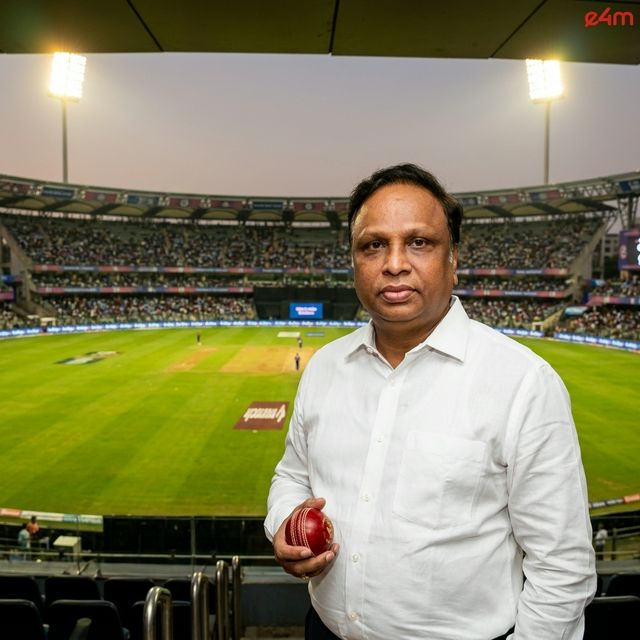
At Wankhede Stadium, Mumbai — home of Indian cricket
From Mumbai Cricket Association to BCCI Treasurer — governance, structure, and grassroots development in Indian sports.
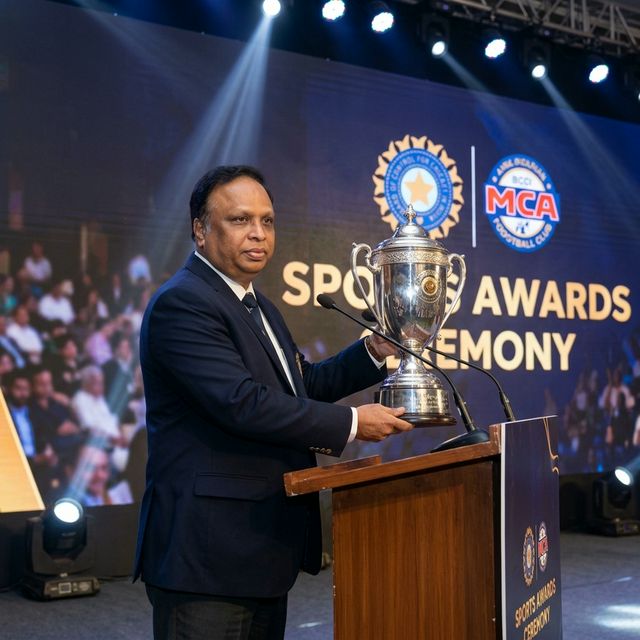
Shelar was elected Vice President of the Mumbai Cricket Association (MCA) in June 2015, entering sports governance at a time when Indian cricket administration was undergoing systemic reforms mandated by the Supreme Court's Lodha Committee. On 12 January 2017, he was elected President of the MCA — inheriting leadership of the association that administers cricket in India's most prolific cricketing state.
Mumbai's cricketing legacy is unmatched in Indian sport: 41 Ranji Trophy titles (more than all other states combined), the training ground of legends from Sunil Gavaskar and Sachin Tendulkar to Rohit Sharma, and home to the iconic Wankhede Stadium — one of the most hallowed grounds in world cricket. As MCA President, Shelar oversaw this vast ecosystem of domestic cricket, grassroots player development, infrastructure management, and the complex administrative machinery that brings together hundreds of clubs, coaches, and umpires across Mumbai and Maharashtra.
Under his leadership, the MCA undertook significant infrastructure upgrades at Wankhede Stadium, modernized player selection processes, strengthened the coaching framework for age-group cricket, and improved financial transparency within the association. The emphasis was on professionalizing cricket administration while respecting the sport's deep community roots in Mumbai's local clubs and maidans — the open playing grounds that have historically been the nurseries of Indian cricket talent.
Following a constitutional amendment that allowed Members of Legislative Assemblies to hold BCCI office-bearer positions, Shelar was elected Treasurer of the Board of Control for Cricket in India (BCCI) in October 2022 — assuming financial stewardship of what is widely regarded as the richest and most powerful cricket board in the world, with estimated annual revenues exceeding ₹15,000 crore (primarily from IPL media rights, ICC revenues, and bilateral series).
As BCCI Treasurer, Shelar managed the organization's complex financial portfolio, overseeing budgets for domestic cricket development, player welfare funds, international tour logistics, IPL financial governance, and infrastructure grants to state associations. He represented the BCCI on the Asian Cricket Council (ACC) board, participating in governance decisions affecting cricket across 25 member nations from Afghanistan to Singapore.
His tenure saw the BCCI navigate significant financial decisions including new IPL team valuations, broadcast rights renegotiations, and investment in India's bid for future ICC global events. Shelar brought the same emphasis on financial transparency and procedural rigour that characterizes his legislative work to the board's operations.
In December 2024, upon being sworn in as a state cabinet minister, Shelar promptly resigned from the BCCI Treasurer position. The Supreme Court's Lodha Committee rules prohibit ministers from holding cricket board positions — a governance norm Shelar respected without delay, setting a precedent for clean transitions between political and sporting administrative roles. Maharashtra Cricket Association President Rohit Pawar publicly praised his BCCI tenure for its professionalism and institutional respect.
Shelar serves as Chairman of the Mumbai District Football Association (MDFA), the governing body representing over 350 football clubs across Mumbai — one of the largest district-level football administrations in India. This role extends his sports governance philosophy to football, the world's most popular sport and one experiencing rapid grassroots growth in urban India.
Under his chairmanship, the MDFA has organized structured, multi-tier tournament frameworks spanning youth development categories (under-14, under-16, under-18), open age-group competitions, women's leagues, and corporate football events. The association has also worked to identify and develop playing facilities across Mumbai's space-constrained urban landscape — partnering with BMC, schools, and private institutions to secure quality turf and training grounds.
He has championed the creation of structured coaching pathways for young footballers, modelled on the BCCI's domestic cricket pyramid. The goal is to create a continuous pipeline from neighbourhood maidan football to competitive district and state representation. Under his leadership, MDFA has also initiated referee development programmes and strengthened women's football participation across Mumbai.
Clubs across Mumbai under the Mumbai District Football Association, spanning grassroots youth development to competitive district-level leagues.
Shelar also serves as Vice President of Rajasthan Sports Club. His engagement with sports administration is characterized by bridging political organizational skills with sports governance — bringing structure, financial discipline, and governance reforms to sporting bodies.
His deep association with sports and arts has drawn support from cultural figures. Marathi actors and cultural personalities campaigned for him during elections — singers Suresh Wadkar and Anuradha Paudwal, actor Vaibhav Tatwawadi among those who publicly supported his 2024 campaign.
Sports governance for Shelar is not a sideline interest or a prestigious appointment to pad a political bio — it is an extension of the same organizational and institutional thinking he applies to politics and governance. The emphasis is consistent across contexts: structure, transparency, grassroots development, meritocratic selection, and institutional accountability.
The principles he championed align with the Supreme Court's Lodha Committee recommendations for Indian cricket governance: clean elections, age limits, cooling-off periods between terms, separation of political and sporting roles, and financial transparency. His own resignation from the BCCI upon assuming ministerial office is a concrete demonstration of this commitment — a step that many in Indian sports politics have historically resisted or delayed.
His trajectory through MCA, BCCI, and MDFA represents a rare combination in Indian public life: political organizational experience systematically applied to sports administration. Where many politicians treat sports body positions as honorary titles, Shelar's approach has been hands-on, operational, and reform-oriented — bringing systematic management, financial oversight, player welfare focus, and developmental vision to institutions that collectively govern millions of players and handle billions of rupees in revenue.
Colleagues in both political and sporting circles note his distinctive ability to treat sport as a governance challenge rather than a leisure pursuit — applying the same data-driven, outcome-oriented approach to cricket talent pipelines that he brings to AI policy taskforces or heritage conservation master plans.